August 17, 2021
Exploring a Bigram System in the Analysis of Ìgbò Ọ̀jà Flute Surrogacy
When I first heard about Dr. McPherson’s niche within the musical side of language, I jumped at the opportunity to collaborate with her. How was there someone out there working at the intersection of ...
Reza Homayounfar
Keywords: Africa, Nigeria, Igbo, Tone, Methodology
When I first heard about Dr. McPherson’s niche within the musical side of language, I jumped at the opportunity to collaborate with her. How was there someone out there working at the intersection of my two biggest passions? Both of us were eager to dive right into a project that would bridge these gaps. Over the past four months, Dr. McPherson and I have been analyzing data of the ọ̀jà flute, originally from a participant-observation study recorded in November 2020 at the University of Nigeria, Nsukka. The ọ̀jà is a small, high-pitched flute native to the Ìgbò people, and it has multifold uses, including being played for important celebrations and people, or simply for relaxation. It is important to note its cultural and mythical significance as well; its place in Ìgbò religion and spirituality (ọdịnala) includes but is not limited to funeral lamenting and use in mmoọnwu, traditional masquerading. For more detailed information, see the report on preliminary ọ̀jà findings by Dr. McPherson’s collaborator Aaron Carter-Ényì et al: https://doi.org/10.3389/fpsyg.2021.653068.
The ọ̀jà’s usage also extends to speech surrogacy, in which it is able to mimic the sounds of spoken Ìgbò, especially the tone system. The Ìgbò language has a relatively simple tone system, with a contrast between low, high, and downstepped-high tones. This limited range, compared to e.g. Seenku tone with four distinct levels, made it a better candidate for bigram analysis, rather than absolute note-to-tone analysis. In other words, we were interested more in the transition between adjacent syllables, rather than their standalone properties. In the remainder of this post, I will be discussing our methodology and reporting on our findings.
The basis of our analysis came from an ELAN transcription of the ọ̀jà flute recording, including Ìgbò captions created by Nnaemeka Amadi and Quintina Carter-Ényì, phonetic transcriptions created by Dr. McPherson, English translations, pitch annotations, and tonal information. First, we exported the ELAN file into tab-delimited text, which was then transferred into Google Sheets. Many of the columns with respect to time markers and English glosses were ultimately discarded, since they didn’t have any relevance to our research question (the relationship between musical intervals and tonal intervals). From there, we moved on to converting the data into bigrams.
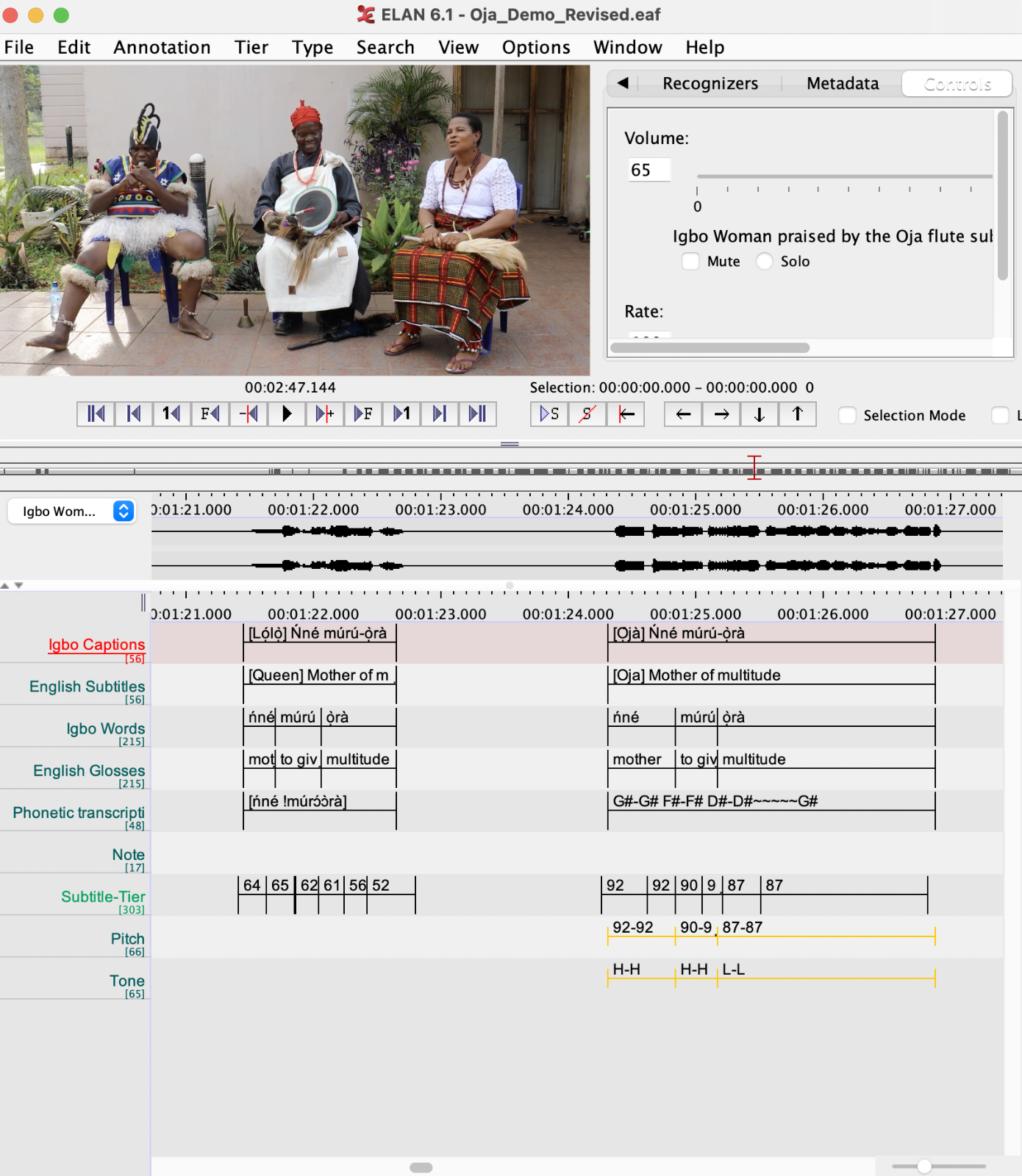
The first step involved listening to the spoken recordings, counting the number of syllables in each phrase, and comparing that to the number of notes in the corresponding ọ̀jà phrase. When they matched, the bigram conversion was relatively cut-and-dry: the first two spoken syllables (syllables 1 and 2) corresponded to the first two notes (1 and 2). We then moved our viewfinder over one syllable and one note (syllables and notes 2 and 3), and so on and so forth for the remainder of the phrase. Each bigram was annotated for surface and underlying tone, in addition to Western scale degrees. When the number of syllables and notes in a certain phrase didn’t line up, however, the process was more challenging. We first attempted to line up syllables from the beginning of the phrase based on likely tone-note correspondences, but if this system broke down part-way through, we tried the same methodology from the end of the phrase. Usually, there was a sequence of two or three notes in the middle without clear correspondences, and we removed these from further analysis. This methodology resulted in a corpus of 80 bigrams.
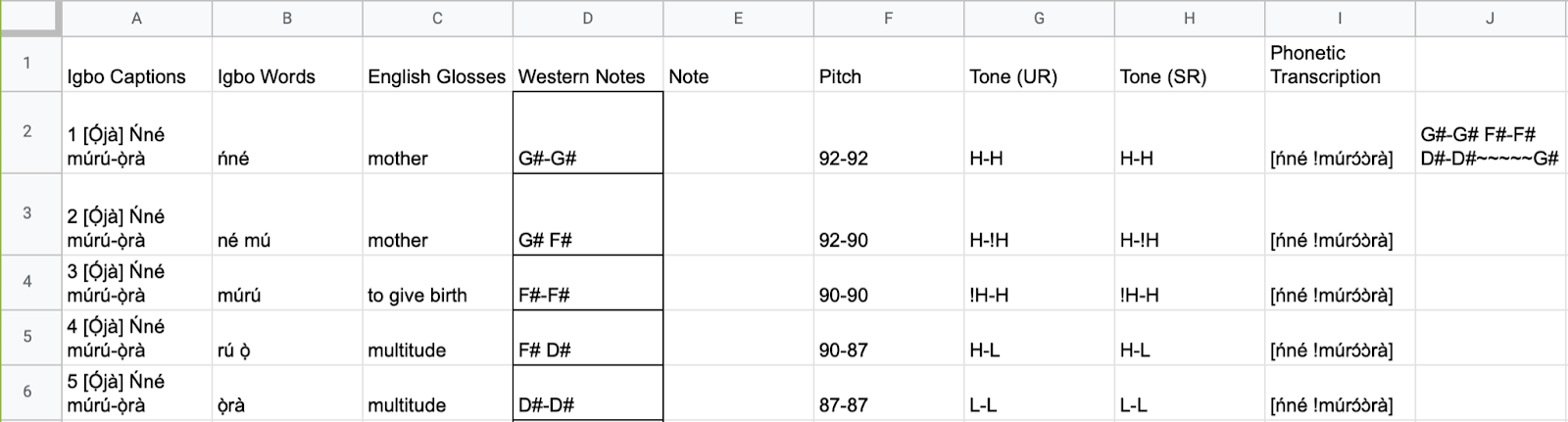
To analyze the relationship between musical interval and tone interval, I created a new sheet organized based on tone sequence (ex. High-high, high-low). I then measured the step interval between each tone in corresponding Western notes (e.g. G# to F# = 1). To our delight, our data exhibited more systematicity than we anticipated. For instance, every high-high sequence but one was played on a level sequence of notes (an interval of 0), yielding an average of 0.04 steps. A similar systematicity was found for the low-low sequences. The difference in interval size between high-low and high-downstep also matched our expectations, with high-low being 1.85, and high-downstep being 1.25. Interestingly, I noticed that many phrase beginnings in the high-low column had the interval of G# to F# (one step), which didn’t match up to other larger intervals in the same category. Dr. McPherson and I discussed some possible artistic and linguistic elements in play that might contribute to these anomalies, for example, the need to reserve some melodic space for the rest of the phrase in order to maintain the clarity of tone encoding.
We discussed these findings with our collaborators in Nigeria, including Aaron Carter-Ényì, Jude Nwankwo, and Quintina Carter-Ényì. One interesting observation that came out of our discussion is that Ìgbò tonal transcription often doesn’t reflect surface downstep highs, and that the location of these downsteps differs depending on dialect. For example, Quintina mentioned that she speaks the Anambra dialect of Central Ìgbò, but the speakers in the recording speak a different dialect. It remains an open question whether the flutist’s close match to the speakers’ dialects means that he also speaks that dialect, or if he is simply mimicking their speech. Another comment made was that different _ọ̀jà_s have different ranges. For example, we noticed that the ọ̀jà in the video consistently played a range of only five notes, but Jude noted that different instruments could vary depending on construction.
From this discussion, we also decided that rather depending on the Western musical scale, we should take the ọ̀jà’s scale as the basis of our average calculations. It would make sense to categorize the intervals based on the ọ̀jà’s inherent scale, such that each adjacent note is an interval of one, rather than calculating them based on Western half-steps. Our basic findings remain the same, but this reduced the variation in some categories such as high-downstep.
While these findings are preliminary, we found that the ọ̀jà speech surrogate tradition is remarkably systematic, and that the bigram analysis can capture this systematicity. We hope to use this methodology as a backbone for future analysis on both the ọ̀jà and other instruments, such as the Ufie slit-log drum used for Ìgbò speech surrogacy.